

The best place for a brand or company to begin their social media quest is to sit down and write out exactly who your audience is. For established companies this may be taking a look at the people that actually already use your product but also looking at the potential of other consumers. A new company has to decide which demographic it makes sense to target first. The answers to these considerations will guide your choices in regards to which social media platforms it is necessary for you to be on. A company that sells wedding dresses should probably be putting more effort into Pinterest than a company that publishes news.
Once you have decided which networks to join, the content you post should also be largely based on your audience. Will it make more sense to use videos to get your content to your followers or will text posts suffice? Maybe infographics are the best way to inform your audience. When you consider how many young people and adults are using their digital devices and how much time they spend on them, it is baffling that people don’t see the value in a social media presence.
Not only should your company or brand be present in some manner but it needs to be active and engaging. Here is where the investment comes in. Let’s say your brand is on social media and you have tailored your content to your audience but your analytics show that you are getting low impressions. Or maybe you have a small reach to begin with. You are set up with your social listening tools. You actively have people on your team following people who are discussing products similar to yours. It is time for paid content.
Why on Earth, after all the effort of creating content and paying people to manage these accounts would you turn around and pay to promote your content? Wasn’t social media supposed to be a great free tool for you to use to advertise yourself to consumers directly? Well sure to some degree. However, most of the social sites that brands and businesses will be using are using algorithms to optimize a user’s feed. Alex York wrote about this in an article called “6 Social Media Trends Taking Over 2017.” York stated that “The majority of these algorithms have one simple purpose–to make its users happy with the content they see in their feeds. But this is making it difficult for brands to be seen if they strictly publish organic social content.”
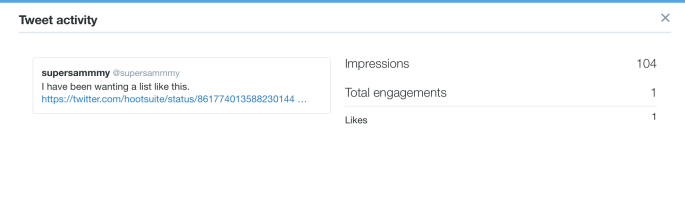
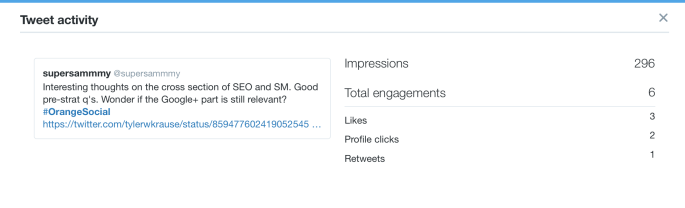
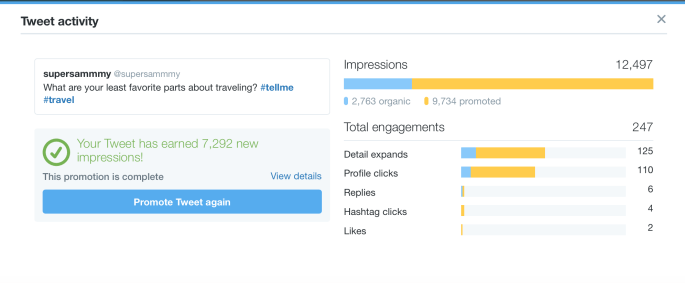
To combat the algorithms, decide on a budget for promoting your social content. As a small experiment, I myself used the promote tweet feature from my personal Twitter account. I will show images of my analytics of a normal tweet, a more popular tweet and then a tweet that I paid to promote. The process was simple and fast. You have the power to decide exactly how much you’d like to spend. I see this as especially great for small businesses that want to give features like paid content a try.
I suggest dipping your toes in the water first. Let the results determine your paid content budget. It may not be necessary to promote every post. Start with posts that have clear, specific and measurable calls to action and that way you can compare your impressions with your conversions. Even though its not always quantitative, people seeing your activity will slowly build a sense of your brand. I know that despite not being a fan of fast food, the next time I am in a time crunch and hungry I will be looking for a Wendy’s because I love their Twitter account. Their content is funny and it makes their account relatable and memorable.
Now, I am no Twitter extraordinaire. Below are some screen shots of tweet analytics. The first tweet is one of my lowest ranked tweets. The middle tweet is one of my highest ranked tweets. The last tweet is the highest ranked tweet I have thanks to paying to promote it. I will let the data speak for itself.
 Superblog