Using Sensors to test Conspiracy #EMPJ Week 7

In our class this week we learned about the use of various sensors that journalists, regular citizens and scientists alike have been employing to check on the powers that be, or to conduct their own experiments. For whatever reason, when asked to apply the idea of sensors with story telling my mind went straight to climate change.

If you frequent the documentaries on Netflix as I occasionally do, perhaps you have also watched the one titled Cowspiracy. The premise behind this documentary is that we’ve all been only told a half-truth about climate change. The normal discourse usually involves some derivative of “monitor your carbon foot-print” and “consider car pooling, walking or cycling to your destination if possible” all in the efforts to decrease our combined carbon emissions into our atmosphere. The ultimate aim is to not mess with our ozone and ruin the green house effect which is what keeps us all nice and comfortably toasty here on Earth.

However, the documentary strays from this typical dialogue and adds that one of the worst contributors of greenhouse gases is actually farms that raise livestock. If their data is accurate the difference between carbon emissions from our transportation and the green house gas emissions from livestock farms is quite considerable. If you don’t feel like watching their documentary, here is an infographic they have made to sum up their concern.

I think that this could be just one way to get people involved in the climate change discussion. I could use a sensor like the hazardous gas monitor to gather my own data to use in a story on the gas emissions by our local farms. The sensor could be taken into the city where you could get readings in what we would suspect to be higher levels of carbon emissions due to the increased transport taking place. I could take it to the suburbs where the area is largely residential and likely to produce mild gas levels. Lastly, in what could be either debunking the con[cow]spiracy or being one more person able to produce similar results, I could bring it to a few of the local farms that have livestock and collect date there. It may also be interesting to bring it to a farm that does not raise animals and see if there is a difference in data there. What could result from this is a look at the gas levels along a radius from the center of the city out to one of its most rural towns. The story would be a take on our local impact on climate change and how our area fits into the issue.

Although, I think that given the split nature of the climate change issue among Americans that perhaps another approach could be useful. Borrowing from idea of the Cicada Tracker project where people were involved in collecting the data themselves and then watching it become a part of a data set online might be a more appropriate approach to help Americans learn about climate change and trust the data that is being collected. Setting up a website that helps instruct people about how they can get and construct their own gas sensors and then have their data contribute to the site’s data collection could be a way to get everyone involved. For those indifferent or those that don’t believe we are contributing to the changing of our atmosphere, this project could feel like a way for them to help “debunk the conspiracy.” In order for that project to work with as little manipulation as possible, my dream sensor for the project would have a GPS tracking device attached so that the data was automatically associated with its actual location as well as a video camera to confirm that the sensor was not being placed in a place that would obviously skew the results, such as a grill or at the end of a muffler.

VR Project Pitch: Solar Eclipse Week 6 #EMPJ

This week we have been tasked to pick a news story that could utilize Virtual Reality and 3D Web technology. The story I would like to tell using these innovations would be about the solar eclipse. Not only has this been a prevalent story everywhere you turn, but I think it could have great applications as far as this technology goes. Using these methods would also set you apart from the standard articles giving path estimations and explaining how to view the eclipse without burning your retinas.

I think that the virtual reality portion of this story comes after the eclipse has occurred. I have seen that organizations like NASA are gearing up for this event and plan on live streaming it. There will be plenty of images that could be used to recreate this event. What I think would be really cool, is to pick one location that is going to experience the full eclipse and have the place recreated at the peak eclipse time. This way people that either missed it or were not in a location that was in the path of the full eclipse, could still experience what it would be like to walk around outside. Could 360 video lend itself to this story? Sure, but I thought I saw somewhere that not all cameras are suitable for capturing this solar event and that equipment’s light sensors could be affected from repeated exposure. I wouldn’t want to sacrifice my gear. Instead, I could use the footage from the NASA live streams, people who are more equipped to record such an event, to recreate one of the locations in VR where all of the equipment is definitely safe from damage. I believe I saw that they would have locations across the country set up and that they would be following its path across the country. This would also give us options as far as which location we wanted to recreate. I am not sure how this part would work, but maybe the eclipse in the VR is safer to view? Since it is artificial the bright light ring around the moon could be dimmed for safety or since it is not actual rays the intensity/brightness could still be accurate but safe to view in VR? Again, these would be logistics I am unsure of.  I’d need to research or contact someone much smarter than myself to get the answers to because I would want it to be as accurate as possible but obviously safe to view.

The 3D web portion of this story I think is a little easier to apply and would replace all the infographics we have seen about the path of the eclipse. With inspiration from The WebGL Globe from the Chrome Experiments, I thought it would have been a much more visually appealing and stimulating way to explore the path of the eclipse. There could be a color gradient associated with view percentages and the path could have been drawn with the respective colors. This would have allowed viewers to search their location and see where they were in relation to the path right on the globe. Such a representation would also allow for people to move the Earth and follow the entire path of the solar eclipse.

Reality Capture Week 5 #EMPJ

I am not going to lie, this week I am having a harder time thinking of how I would apply the technology we discussed in class, to creating stories. Reality Capture certainly lends an amazing ability to replicate a landscape, an object, or a person, but as far as it being the mechanism solely through which I told a story, I would need to experiment with it more. That being said, I think that reality capture is a great way to add to a written story. I know both as a writer and a reader that words do not always have the ability to capture what we see through our own eyes. Especially for those that are visual learners, seeing something for yourself is the difference between a cursory understanding and a deep understanding.

This reality capture technology seems like it would be great for educational purposes. Instead of sitting in a class hearing lectures or just taking notes, I can’t imagine what it would’ve been like to instead maybe have an iPad in hand, and as the teacher guided you through the historic place telling you what happened there, you could simultaneously be exploring it and envisioning the historic event in a contextual setting. Pictures and videos can’t give certain situations justice when you’re considering that landscapes change or how the reality capture gives a better sense of depth and distance.

With such a brief experience with it, so far, I think that the ability to use the reality capture to then create files that can be used in Unity3D is where I would pursue its benefit to story telling. Rather than trying to find assets that others have made that are close to what you need, you can use 3D scanning to capture things in our physical world and bring them into virtual reality. This helps to recreate the physical setting of whatever story you’re trying to tell so that your audience can be immersed in an event they did not partake in, or explore a place for better understanding.

My goal, no matter how I am telling the story, is to bring people information that I feel is important. No matter my hypothesis for testing this technology out in a field test, my measurement for success remains the same. How do people feel about the subject of my story? Was the element of the reality capture lending to a better understanding of the story? Did it help the audience better empathize with the story? I think that it would be interesting to tell a group of people the same story using two different deliveries. You can use a more simple, or traditional means of story telling as a control group. I would compare their reactions to the two different stories and see how the answers to the questions above compared to each other.

360 Video Potential #EMPJ Week 4

There is already some pretty great content out there for story consumers via 360 video. This week we took some time to learn a little bit about the process of creating 360 videos and considered the ethical concerns they raise. One of the concerns is “staging” because the equipment has to be set up and then walked away from and some go as far as to hide so they don’t interfere with the scene. I see why this is problematic for some people.

There is already so much distrust for media as it is, it doesn’t seem like a good idea to employ story telling tactics that could be construed as deceitful. That being said, I don’t think that makes 360 video an impossible candidate for journalistic story telling. As others are tackling these issues, my classmates and I will be a part of exploring and defining the practiced boundaries in ethics should we pursue 360 video as an avenue of story telling.

360 degree video lends itself to telling stories in which you don’t want to leave anything out. It allows you as the story teller to drop your audience within the setting of your story. Right now, while people wrestle with putting sensitive images within 360 video and whether or not it makes our audience more empathetic or more desensitized, I think the greatest opportunity is just letting people see the world.

The world is so incredibly vast. My travels have humbled me and slowed me down quite a bit. I like to stop and take a look around. I take everything in and try to remember all the details so I can come back to that moment later. I got my strong yearning for travel from my grandmother. She has always had many stories of the places she has been and the people she met while she was there. Now that she is older she can’t quite travel like she used to and she lives vicariously through those of us that are able to travel. She is likely the first to traverse my Facebook albums, my Instagram posts and my snapchat story, at least when she knows I am traveling. And yes, my grandma has and uses Instagram and SnapChat. She is ~hip~.

Old age is not the only thing that holds people back from getting to see the world and listen to the stories that happened in whichever foreign place was the destination. I’d love to use 360 video to show different places all over the world. While I travelled in Europe , there was a company that I came across that did tours for only a donation. As I travelled from city to city we looked for those tours. In my mind I picture a tour guide like that, bringing you around a place and telling you the story right where it happened. Just like I did, viewers have the chance to look around. They choose where to look and what to see right from where they are.

I think that this basic concept would make for a relatively simple field test. The goal of these travel pieces would be to bring you closer to another place, hopefully one that the viewer didn’t know much about before. The phrase ‘out of site out of mind’ came from somewhere so the bigger picture is to close the gap between them and us, and make people empathetic again. I could create a simple quiz or survey about the place of choice and see how people feel before and after watching the piece. The responses to the quiz/survey would be how I determined my success. Did people leave the experience having learned something about a new place? Have I created at least a small connection for them to this new place?

Experimenting with Unity3D Week 3 #EMPJ

I sat down at my computer Friday night watching tutorials about how to use Unity3D for beginners. I messed around with it a bit and thought, hey, this won’t be so bad. I sat down Saturday morning and began crafting my own world. The next time I looked at the clock it was 2 PM. I had to have found a worm hole. There in the corner of my bedroom, by my desk, was a time-sucking worm hole. However, to my dismay, it was just my complete lack of ability to operate this new program. Eventually, I got the hang of doing some of the simpler tasks. I had to restart so many times because I would get so far and then I’d come across some error that I could not resolve. My biggest tip for other beginners would be to check your console frequently for compiler errors, almost after each change or addition you make to your scene or project. This way if you come across something you can’t fix, you could just delete the element and try to find a different way to achieve what you were going for.

While I was working on my own world I thought of how useful this program could be for really fleshing out news stories. There have been many times where there are complex crime scenes that you can’t quite visualize or the story takes place in an unfamiliar place. Once I got a better grip on the controls of the program I was able to create my world pretty quickly, so I can’t imagine how much faster someone with more knowledge and experience could create something.

This experience brought me back to the digital divide, or the gap between people with the proper tools/access/knowledge of digital technology and those without. There are many factors to this idea, but it basically boils down to that. I thought this concept was relevant because I feel like it contributes to the changing news-consuming audience. Generally speaking the news is intended for everyone, but when journalists are thinking about how they can tell their long form stories to a generation of people that aren’t reading long form journalism, it felt like virtual reality could be a part of the solution.

The newer generations are more likely to be in the part of the digital divide that knows how to use the technology. They will have grown up on more and more technology. If there is speculation that attention spans have gotten shorter across much of our population, who is to say that won’t continue to get worse? I foresee a problem with written journalism being able to be sustained. I sense that since there is so much video being consumed, no matter how good a video is, it is still just a drop in the ocean. After using Unity3D I had the sense that immersive journalism could be one answer.

Check out my Unity3D World!

Television Viewing: The Innovator’s Dilemma #EMPJ Week 2

When I was a kid I remember on Sunday nights my family would sit down after dinner, watch whatever Disney movie was playing on television that night and help my mom fold the laundry. Although, I was only good for matching the socks together back then. On Friday nights we would order pizza and rent movies from a Video Gallery in town. As time went on, we had more and more choices of what to watch. More and more channels became available in various cable packages and we started collecting DVDs. Then there were On-Demand channels with catalogues of free or low-cost rentals. Deciding on something to watch grew much more difficult as time went on. It became less spontaneous and more of a choice. 

Let’s rewind to the beginning of at-home television viewing and set up our sustaining innovation first: the television. If you were lucky to live in a home with a television, people and maybe neighbors would gather around it for particular programs and share in that experience. That is, when there were programs to watch. Eventually, it became a regular household object and programming grew. It started with broadcast channels and antennas. There was only so much space available in the airwaves and the content therefore could be regulated quite a bit. Technology developed and cables were introduced to help viewers receive the content better, thus sustaining this technological innovation. Pay-TV and cable programming kept sustaining the television’s development.

The disruptive innovation began much like a drop of water in a pond. It started so small but it rippled right across the industry. Networks began posting their shows on their websites and then there were other sites that would post the shows as well. The latter usually being a little dicey in ethics but people didn’t care. They were just excited they could watch their show before one of their co-workers ruined it for them. This brought television viewing to your computer. With the concurrent development in technology in digital devices and the internet, television wasn’t only for TVs anymore. You could watch on any device with an internet connection. 

The sustaining innovation was kind of able to continue growth with the aforementioned On-demand channels. The cable providers could get you to subscribe to certain networks which then granted you access to the catalogue of their shows but at your viewing leisure. As the companies and their technology became more sophisticated they were able to offer recording services with your cable box, like DVR or the service TiVo, with the ability to pause, rewind and fast-forward your live-programming. People could also pay into extra services that fit their television viewing tastes. 

The disruptive innovation answers with streaming services that had cross-network catalogues as well as movies. The big one that comes to mind, was Netflix. This one in particular is a stand-out because while there are others like it, you do not need to watch commercials. I also enjoy Hulu especially in the rare case when I have caught up to the show in real time. After successfully binge watching the six seasons that are available on Netflix, and you’re dying to know what happens next, if you are lucky, it is on Hulu. Even though there are still a few commercials, you don’t have to be in front of the TV at the specific time on the specific day that your favorite show airs on.

I know for a family like mine, it no longer made sense to pay for these crazy large cable packages. Eventually we cancelled it altogether. With the exception of sports, we had everything we needed between Netflix and Hulu.

The Cross-Section of Future Media and Technology #EMPJ

It is hard to say at this point what exactly I expect my career to look like. For the first time ever I have not constructed a plan for my immediate future. I wanted to be mentally open to seize a variety of opportunities within this broad and expansive field of Communications. With that being said, I am on the Journalism Innovations track so that gives some degree of direction as to what I’d like to do with my new knowledge and skill set.

This week in class we covered some technologies that I had never heard of and a few that I had. As we were introduced to these innovations we were asked to consider what aspects came true, what became out-dated, or what missed the mark.

Some were innovations that I missed from the past such as the 1983 VideoTex; the Viewtron System and Scepter Videotex Terminal from AT&T. This allowed customers to do a variety of tasks such as banking, games and checking the weather from their televisions using a keypad.

Another example was the SixthSense technology developed by Pranav Mistry in the years leading up to 2009. With his wearable gear you could take pictures without a camera, annotate objects, and bring the digital to “life” and bring life to digital.

In a TED Talk we watched George Bloom describe his Meta-verse of virtual reality. He discussed the potential for a smaller carbon foot print if film-makers were able to use virtual sets for their movies instead of finding actual locations.

If you are listening to developers today you hear about the use of AR and VR (Augmented reality and Virtual reality). There were recently a few articles surrounding Elon Musk’s comments surround AR/VR, warning about the potential dangers of these technologies as well as a video created of “Barack Obama” made by an arsenal of audio and video files stitched together to make a new video– something never wholely spoken by former President Obama. In a day and age where we are already facing severe problems with news sources, fake videos could only make matters worse.

I see people on Facebook still sharing articles from The Onion not realizing it is satire. I think one of the things to come in conjunction with technological innovations are labels. Perhaps not in their original settings, but once they appear on social media they will have some indication. Just like with nutrition, people will have to label their content. If it is satire, they will need to label it as such. If it is a blog, it will need to be clearly labeled. People will need to know an articles’ ingredients and if none are present it is a certainly a good way to rule it out as a reliable source. As new teams come into play within different social groups, like those just beginning their partnership in journalism for Facebook, there will be more regulations on social networks towards news articles.

People will begin to walk the fine line between virtual reality news stories and augmented reality news stories and given their realistic components it may be even harder to differentiate real from fiction. 360 degree images and Virtual Reality video could lend incredible authenticity and immersion to news-readers but due to that real-factor it could also lead to a larger margin for misleading your audience and a larger margin for affecting your audience. Studies have shown that Virtual Reality media tends to be a bit more impacting, which means that in the hands of someone with a specific mission,  they could more easily achieve their goal of persuasion.

This is off the mark with journalism though. Maybe there is some small point that a journalist is trying to get across but ultimately the goal is to inform. People can make their own decisions after reading or watching a journalist’s piece but straight persuasion is too close to propaganda for our Democratic Republic.

The equipment necessary for VR or AR right now is too directive for journalism at this point. The subjects are too aware of the people present. The gear is not easy to ignore. People behave differently when they know they are being watched. Until less bulky or more integrative equipment can be used it is problematic for journalistic story-telling.

So as people have an easier time creating alternate realties whether it is VR or AR, or through technologies like the meta-verse I think news-consumers will have a harder time assessing the truth from fake news by themselves. There is a potential for an incredible up-hill battle for journalists and story tellers. I see the divide between believers and skeptics getting bigger. If the internet continues down this path of complete disillusion and unsystematic news-telling then there will continue to be a serious “fake news” problem for countries. The “sources” people could include might be harder to discredit upon initial viewing, especially with the AR/VR capabilities.

As a potential content creator or manager the technology excites me. You can tell immersive and engaging stories like never before. However this means that if the technology was being used by people with specific motives they could be very successful in deceiving their audience as well.
I think if our media companies and government were cognizant of the potential for damage, they would be creating some guidelines or laws for publishers and writers, both the large and small players, along with establishing clear and easy ways for people to perform online “citizen’s arrests” against people they find in violation of the law. There is just too much to cover online and people need to be better equipped against what they might find online.

Improving Your Insta Skills #OrangeSocial

I have been reading a number of articles lately focusing on Instagram. It is no surprise to me. Brands looking to branch out to younger audiences know they can find them there. A blog post on SproutSocial broke down several social platforms by their demographics. According to the March 2017 post, 59% of people between the ages 18-29 can be found on Instagram.

Instagram continues to roll out features that make it more conducive to conducting business and getting those followers to turn into conversions. Can you make the most of their features?

I will list some of my favorite Instagram features and some that I just learned about and why I think they are important to your Instagram brand. I will number them as they appeared in Hootsuite’s list so that you can more easily find directions on how to execute these features.

Profile and Post Aesthetic 

#13 and #18 Sometimes you need a line break to make the text look more organized. Whether you are in your Instagram bio section, or if you are captioning a post, you can use line breaks to make it look more pleasing to the eye.

$15 Are you trying to grow a brand on Instagram? Perhaps the “likes” and “followers” aren’t quite enough information to measure your strategy’s success. Switch your account to a business profile to get better insights.

#29 Even though hashtags are useful for brands and joining in on conversations, some people don’t like them. It is especially frowned upon to do the hashtag overload, even though using the many applicable hashtags helps your posts get out there to people searching for those key words or phrases. This hack suggested that you “hide” your hashtags by posting your content with its plain caption, and by commenting those hashtags immediately on your post.

Use

#3 You can rearrange the order of the Instagram filters and apparently hide the ones you never use. I think this is helpful because I usually go through each and every filter to see which best suits my photograph. However, there are definitely filters I do not use. It would save me time and make posting photos much more efficient.

#6 If you have a personal account and you also operate the Instagram account for a business or a brand you can add multiple accounts on Instagram without having to log in and out of the different profiles. I think this is especially useful for small business owners because they are likely to have that much control over multiple accounts. I think this feature allows for an ease of use that does not inhibit the platform’s use.

#10 Did you see a post that gave you inspiration? Did you see a post that you think could help inform your strategy but don’t have time to utilize it when you see it? You can save posts on Instagram for later, and for your eyes only.

#37 You can use the Live Photos feature from your phone and turn it into a boomerang. I repeat, you can turn Live Photos into boomerangs. These seems to be a favorite among Instagram users so get in on the fun. Forget to take a boomerang? Take your photos in live mode and they can be transformed later.

Brand Listening and Community

#5 When you click on the heart icon in Instagram, it shows you your notifications. This is because it defaults to the “You” option. If you click on the “Following” option, you can see the content your followers are liking and the users they are following. As a brand this can be very useful in seeing what posts are getting engagement within your followers. This can help your social team figure out how your own content fits into your followers “likes.”

#8 and #9 As a brand maybe you feel strongly about certain issues and your content begins to attract a lot of negative comments. You may not want to allow your comment section to foster such a vulgar discourse. You can delete comments as well as filter out specific words you’d like and essentially filter out the trolls. Some brands have had much success by facilitating a strong sense of community on their platforms and you don’t want to let internet trolls interfere with your community’s bond.

For a full list of Hootsuite’s “Instagram Hacks” with the directions of how to execute these hacks click here: https://blog.hootsuite.com/instagram-hacks/?utm_source=twitter&utm_medium=owned_social&utm_campaign=hs_corp-bau-glo-en—owned_media-social_hootsuite-&hootPostID=f661229adcba1d3cab8957527257e7bb

For more social media platform statistics click here: https://sproutsocial.com/insights/new-social-media-demographics/#instagram

Color Psychology; Another Way to Curate Your Content #OrangeSocial

There have been many studies regarding color and the way we interpret them. While it does depend on each person and how much they like the color, there are general patterns that emerge. 

Experiments have revealed that certain colors make respective parts of the brain increase activity, or “light up.” In addition to this, people have collected associations for each color that are common among those that like those colors and those that dislike the colors. Following the link below will bring you to a longer more inclusive list of associations. Red tends to be a very striking and stimulating color as well as yellow. However, red can seem aggressive to those who aren’t a fan of red.  

http://snip.ly/ife24#http://www.socialmediatoday.com/social-business/color-psychology-branding-industry-colors-explained-infographic

Even further, colors can mean different things within different contexts. This is why choosing colors very carefully for your brand and your messages can be so important. Towergate Insurance analyzed 520 company logos and separated them appropriately by their industry. 
The visual allows you to see which colors are predominantly used by industry. The infographic then applies what we know about colors and the emotional responses they typically evoke to describe the message company logos send to consumers. For example, within the context of the food industry seeing red can stimulate a persons hunger while green is connected to being healthy. See the link below for more examples of color associations within different industries or the image at the bottom of this post (which is the infographic from the article). 

http://snip.ly/ife24#http://www.socialmediatoday.com/social-business/color-psychology-branding-industry-colors-explained-infographic

This logic can and should be considered outside of just a brand’s logo. Advertisers have been using this information to articulate certain ideas about brands. 

Whether you’re developing an ad series, a campaign, a social post, revamping the company website and/or logo, carefully consider what message you’re trying to send. We have seen social media soar in relevance and effectiveness as a business-means and that has had a lot to do with story telling. Social media has been a very effective way to communicate with consumers and to tell them your story. There are more chances at striking emotional connections with consumers through that social presence which in turn has an effect on consumer feelings toward your brand. 

Let your color conscience help you demonstrate the exact emotions you’re trying to convey to consumers. 

The image posted with this article is not mine and can be found by following the second link from the top.

Day 1: Getting to Uni

There we were safely on a train, still not one hundred percent sure this was the one we needed. I had expected to be able to get wifi at the airport so that I could iMessage my mother who was dreading the day I stepped foot on an airplane. Between the rush of getting our luggage and finding our train I had little luck in connecting to the wifi.

I sat there staring out at Manchester through the window. It was a strange little city. Old buildings sat there in harsh juxtaposition with newer buildings. I was anxious to get to the school because I knew my mom was at home, not sleeping, waiting to hear that I was safe. Also, I was half expecting to ride the train to the end of its tracks and realize we were on the wrong one.

We did in fact make it to Lancaster. Once we got off the train we figured the best way to get to the school was to get a cab. The two girls who were sitting in front of us on the train got off at the same spot. Turns out we were all headed to the same place. We caught a big cab and piled on in with all of our luggage. Once we got to the school the driver said, “that’ll be ten quid.” I just looked around in fear. What was quid? I thought this country used pounds? One of our new friends handed him the money and we all got our things to go to registration. Once he drove off I asked them what a quid was. Turns out it is just slang, the way we would say 10 bucks in America instead of dollars.

We dragged our luggage across the campus to go register and get keys to our room. After we were all set with those pesky school logistics we all made our way to our flats– once again dragging our luggage across the campus. Luckily we were all in the same building just different parts of it. At this point we all went our separate ways to our temporary homes.

I dragged my luggage all the way up three floors to an empty flat. Apparently the international students are welcomed a week early to have time to settle in and adjust. This was great but a bit tricky. I had no one to ask when I couldn’t figure out how to make the shower hot. The first week I was there I was taking ice cold showers. Anyhow, there I was all alone and incredibly anxious. The school gave us these nifty packages of the “essentials” so I needed to make my bed and unpack and figure out the internet situation so I could skype my mother. I couldn’t figure out the school’s wifi and I did not get any kind of international plan so my phone was useless.

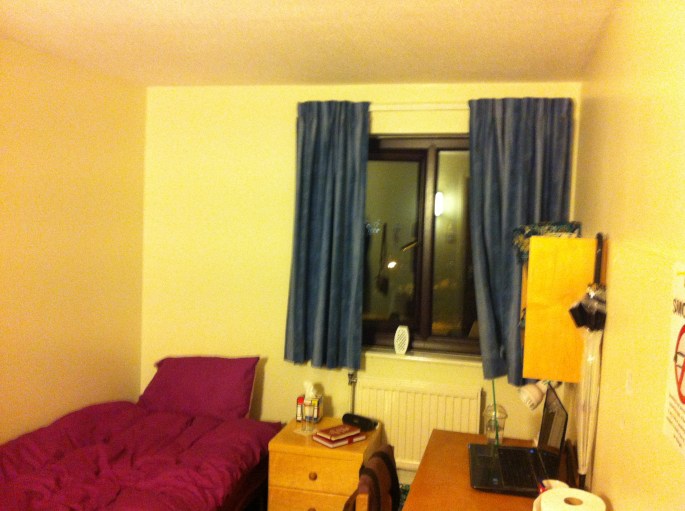
I skyped my poor mother who looked as if I had been traveling for a week before she heard from me. I showed her my tiny little piece of England that I would be calling home for the next three and a half months. The room was quite small which was fine but it was the bed that was the bane of my existence. It felt as if I was receiving a hand-me-down from a sumo wrestler who had spent their days just sleeping on this bed. The springs were so close to the surface I often thought they would poke through. You could not lay in this bed without rolling back into the middle. As I unpacked I grew anxious for all the things that were to come. I was excited and wanted to make the most of every second that I was there.

IMG_0054


The Social Media Investment #OrangeSocial

The best place for a brand or company to begin their social media quest is to sit down and write out exactly who your audience is. For established companies this may be taking a look at the people that actually already use your product but also looking at the potential of other consumers. A new company has to decide which demographic it makes sense to target first. The answers to these considerations will guide your choices in regards to which social media platforms it is necessary for you to be on. A company that sells wedding dresses should probably be putting more effort into Pinterest than a company that publishes news.

Once you have decided which networks to join, the content you post should also be largely based on your audience. Will it make more sense to use videos to get your content to your followers or will text posts suffice? Maybe infographics are the best way to inform your audience. When you consider how many young people and adults are using their digital devices and how much time they spend on them, it is baffling that people don’t see the value in a social media presence.

Not only should your company or brand be present in some manner but it needs to be active and engaging. Here is where the investment comes in. Let’s say your brand is on social media and you have tailored your content to your audience but your analytics show that you are getting low impressions. Or maybe you have a small reach to begin with. You are set up with your social listening tools. You actively have people on your team following people who are discussing products similar to yours. It is time for paid content.

Why on Earth, after all the effort of creating content and paying people to manage these accounts would you turn around and pay to promote your content? Wasn’t social media supposed to be a great free tool for you to use to advertise yourself to consumers directly? Well sure to some degree. However, most of the social sites that brands and businesses will be using are using algorithms to optimize a user’s feed. Alex York wrote about  this in an article called “6 Social Media Trends Taking Over 2017.” York stated that “The majority of these algorithms have one simple purpose–to make its users happy with the content they see in their feeds. But this is making it difficult for brands to be seen if they strictly publish organic social content.”

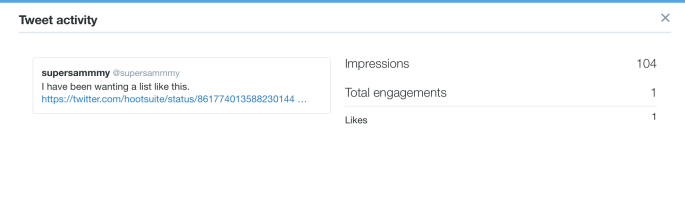
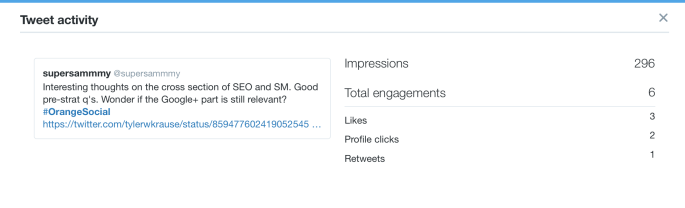
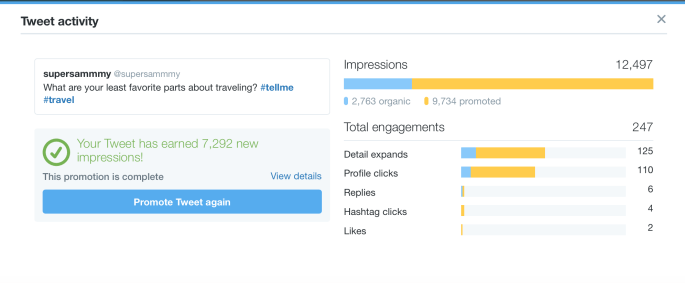
To combat the algorithms, decide on a budget for promoting your social content. As a small experiment, I myself used the promote tweet feature from my personal Twitter account. I will show images of my analytics of a normal tweet, a more popular tweet and then a tweet that I paid to promote. The process was simple and fast. You have the power to decide exactly how much you’d like to spend. I see this as especially great for small businesses that want to give features like paid content a try.

I suggest dipping your toes in the water first. Let the results determine your paid content budget. It may not be necessary to promote every post. Start with posts that have clear, specific and measurable calls to action and that way you can compare your impressions with your conversions. Even though its not always quantitative, people seeing your activity will slowly build a sense of your brand. I know that despite not being a fan of fast food, the next time I am in a time crunch and hungry I will be looking for a Wendy’s because I love their Twitter account. Their content is funny and it makes their account relatable and memorable.

Now, I am no Twitter extraordinaire. Below are some screen shots of tweet analytics. The first tweet is one of my lowest ranked tweets. The middle tweet is one of my highest ranked tweets. The last tweet is the highest ranked tweet I have thanks to paying to promote it. I will let the data speak for itself.

Screen Shot 2017-05-15 at 5.16.11 PMScreen Shot 2017-05-15 at 5.15.31 PMScreen Shot 2017-05-15 at 5.11.30 PM

Taking Flight

This September it will have been 4 years since my semester abroad. The experience completely changed my perspective and set me in motion. I felt awakened. Having the ability to study in another country for a semester is such a unique experience. I had an incredible schedule with classes only three times a week. Being there as a student with no working visa, any time not in class or doing homework was available for exploring.

I need an outlet for reminiscing on some of my most memorable days so here I am.

On Septemer 11, 2013 I stepped foot onto an airplane for the first time. I was headed for Lancaster, England. The journey would consist of one pitstop in Chicago before heading over the Atlantic Ocean, then landing in Manchester where I would have to take my first train ride (ever) to Lancaster. I was traveling with another student from my college and neither one of us were quite sure what to expect.

I remember the early morning we landed, Manchester was hidden by thick clouds and fog. We could not tell if we had just landed or if we were experiencing light turbulence. Once we deplaned we got our luggage and bought our train tickets. We hurried to catch our train and we were hesitant once we got there. We were not convinced we were at the right train and it was getting too close to departure time for comfort. We had to make a decision: were we getting on this train? I banged on the door to get a girl’s attention and she pressed a button to let us on. I looked back to see my traveling buddy had fallen on the platform and she was picking herself up to get on. I held the door for her and we looked around the train for signs we were headed for our destination.

We asked a pair of girls that looked to be about our age if this train was going to Lancaster and they said, “gosh I hope so. That’s where we are going, too.” Those two girls ended up not only being classmates at our university but some of the closest friends that we made while we were there.

535893_10201536905536093_400096331_n