
Skip the Bow Wow Challenge #OrangeSocial

It does not feel like that long ago that a young man I knew as Lil’ Bow Wow was getting me amped to play basketball because “I like the way they dribble up and down the court.” Now, I am reading headlines about how the rapper posted a picture of a private airplane with a caption leading his followers to believe that he was flying to New York City in style.

However, social media serendipity had another plan for him. A snapchat screenshot surfaced on Twitter calling Shad Moss, AKA Bow Wow, out for flying a commercial flight to New York City. A new internet challenge was born: Bow Wow challenge. People began sharing images of forced perspective that gave the appearance of a life more glamorous.

Emma Haak wrote an article called “What the Bow Wow Challenge Says About the Pressures of Social Media” in which she discussed the overarching pressures that everyone faces on these platforms. In it she says, “But the sad truth is that most of us use social media the same way, even if we’re not fibbing about something as seemingly highbrow as flying private instead of commercial.”

I think what brands should be taking away from Moss’s blunder here, is that people are watching and paying attention. Instead of trying to stretch the truth to maintain an image, social media provides a platform that could be being used for transparency. We are living in a time when comparing yourself to people has never been easier and harder. Easier in the sense that for many, there is a constant connection to images of other peoples’ best lives. Occasionally there are stories that show incredible honestly and vulnerability but they are sparse in comparison to the beach shot or the drinks-with-friends shot.

It is harder because as social media consumers, we typically see results. The fitness fiend or body builder in a pose. The entrepreneur enjoying their compensation. The favorite celebrities in beautiful clothing with beautiful hair and make-up. The master chef’s gorgeous meal. Instead of only comparing ourselves to those that we see around us, our eyes are wide open to the multitude of social media posts headed to our feeds.

Too often we don’t see the journey that brought them to that one snap shot. I scroll through my Twitter feed and every few tweets I see photos captioned “#goals.” People yearn for what they see in these photographs but I often wonder if they knew what was out of shot, or the path that lead to that shot, if it would still be something they wanted.

Brands with a presence on social media have an opportunity to push the honesty posts along and participate in solidarity with the human experience. People that push that boundary often end up scrutinized for “just wanting attention” or some apathetic derivative. Companies have the potential for larger follower bases and therefore what they post can influence what people find acceptable to see and post on social.  Letting followers get a glimpse now and then of the hard work that goes into some of the big productions or even in the daily functioning of the business could help bring back perspective. With transparency comes trust and trust builds brand loyalty.

There is a reason that Snapchat has been such a powerful media player. Snapchat users go throughout the day with their favorite celebrities. Users see images of pre-glam stars and seeing the arduous process they actually go through before a red carpet event. You can see just how demanding their schedule is. Kevin Hart shows just how early he gets up to get in his work out, and he takes his followers to his meetings, and to his sets. It makes them more relatable or for me, in Kevin Hart’s case, inspired because I currently cannot relate to his fitness drive or his energy level. It gives me a whole other level of appreciation for him and his work. As he saw great success during his last tour selling out at massive venues, I do not think I am alone in my admiration for him.

Its time for social media efforts to get real and use any of their tools to let your followers in. People like feeling like they are apart of something. They become so much more invested than they would if they were detached from your brand. Don’t let the pressures that resulted in the Bow Wow challenge hold you back from creating transparency.
ICC 612: WordPress

Asynch prompt:

1) Based on your experience with WordPress, what are your impressions with working with WordPress – the pros and cons? It started as a blogging platform but has evolved – should it still be relegated for small blogs, or do you see enterprise use?

In my brief experiences working with WordPress, I would say that I feel there are more pros than cons. It is pretty straightforward to use. I have managed a blog before without using WordPress and I have to say, it is much more user-friendly to use WordPress. This does not come at the cost of user-individuality either because customizing the themes, backgrounds, etc, was not at all what I had imagined. The presentation of my posts was up to me and there were quite a few options. Usually what turns me off from a blog is the idea that is is this winding composite of posts with little organization but you can set up your site so that there are easy navigating functions. This makes it much less overwhelming.

The analytics are also incredibly easy to decipher. I will use the term straightforward again. I can see how easily an enterprise could adapt a WordPress into much more than a small blog. The APIs that are available to integrate would elevate the visitor experience. The site layout options also differ quite a bit and a creator could chose to distance their website from appearing like or functioning like a blog. I think as more people are online with little having any education in website building WordPress seems to have really streamlined the process and allowed for people to create their own page. In my mind this opens up the opportunity for smaller businesses to compete without having to hire people/agencies to create and/or manage their website, which in this time has become expected of businesses to have.

Find Your Message #DigCommSU

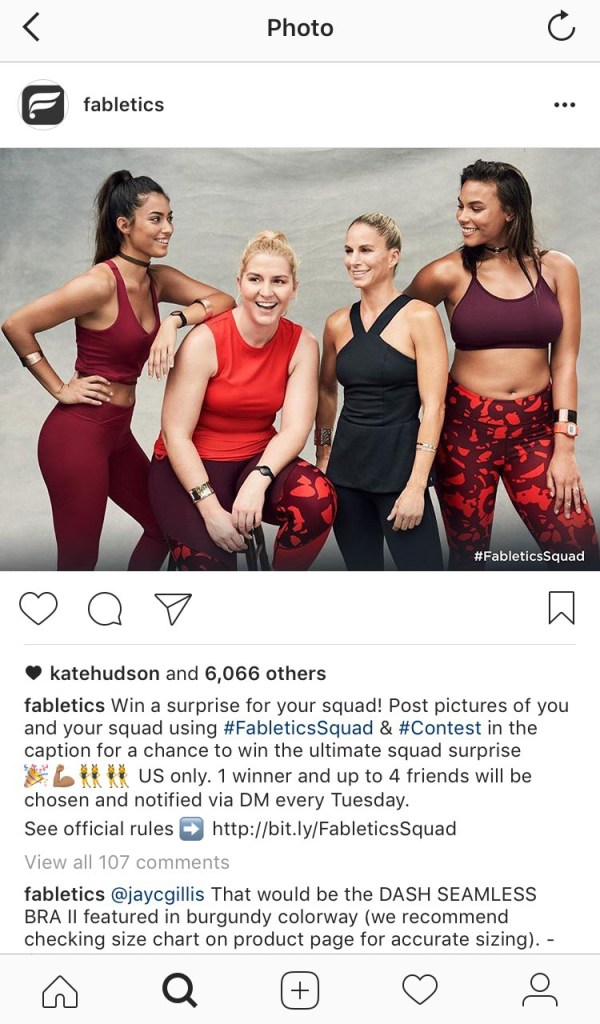
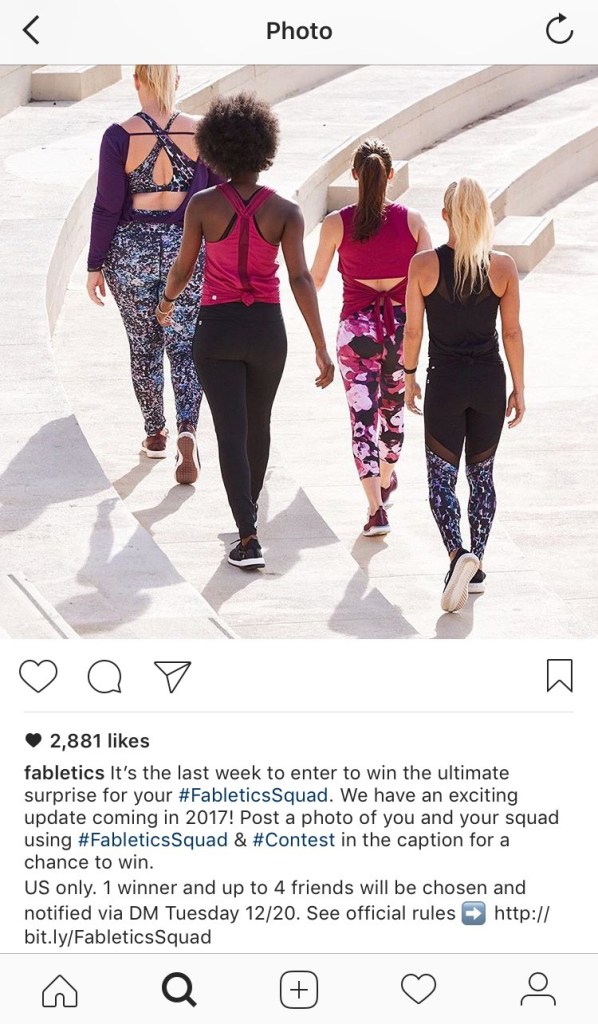
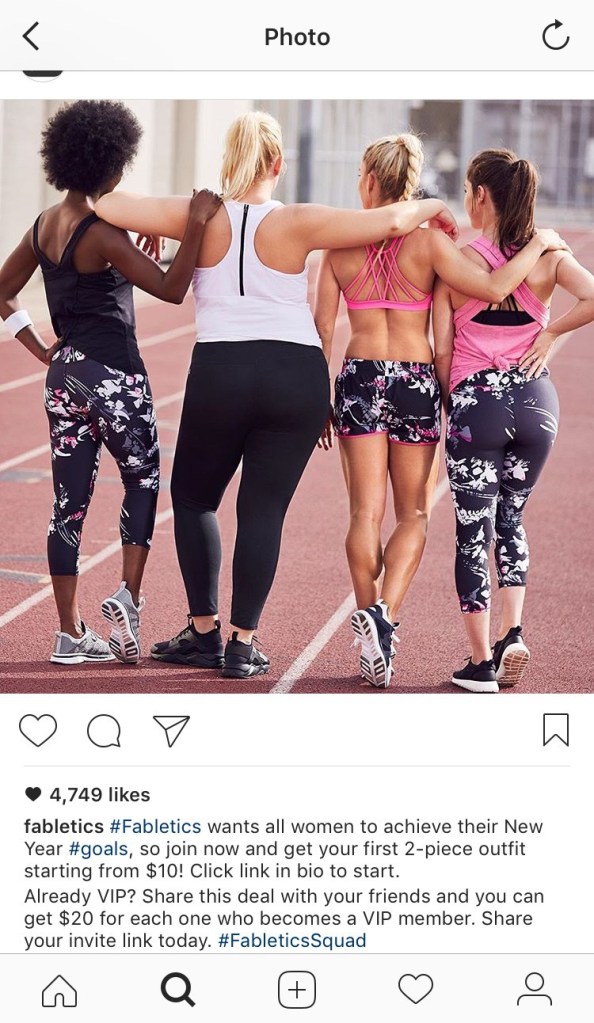
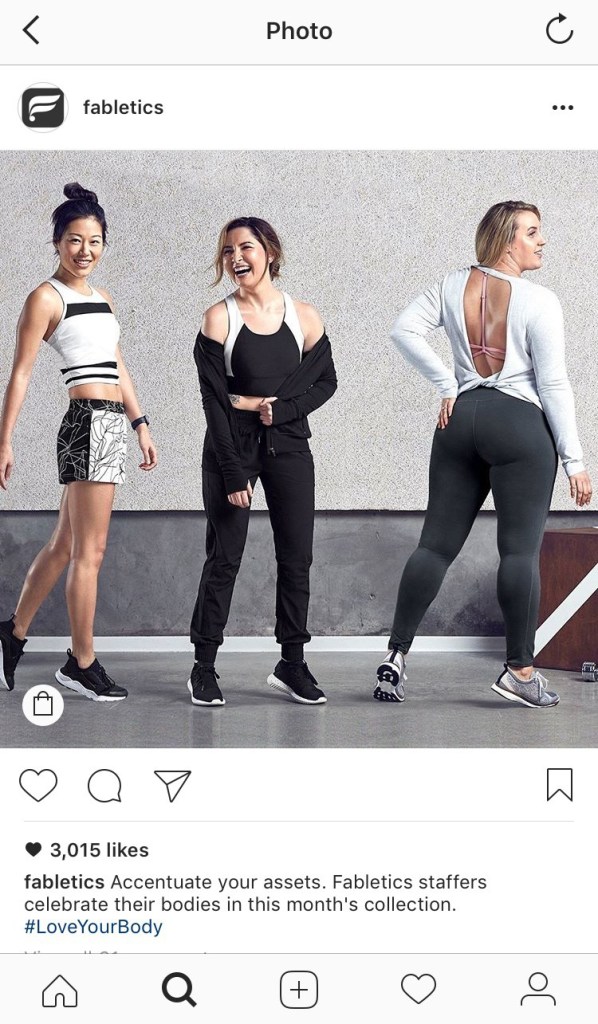
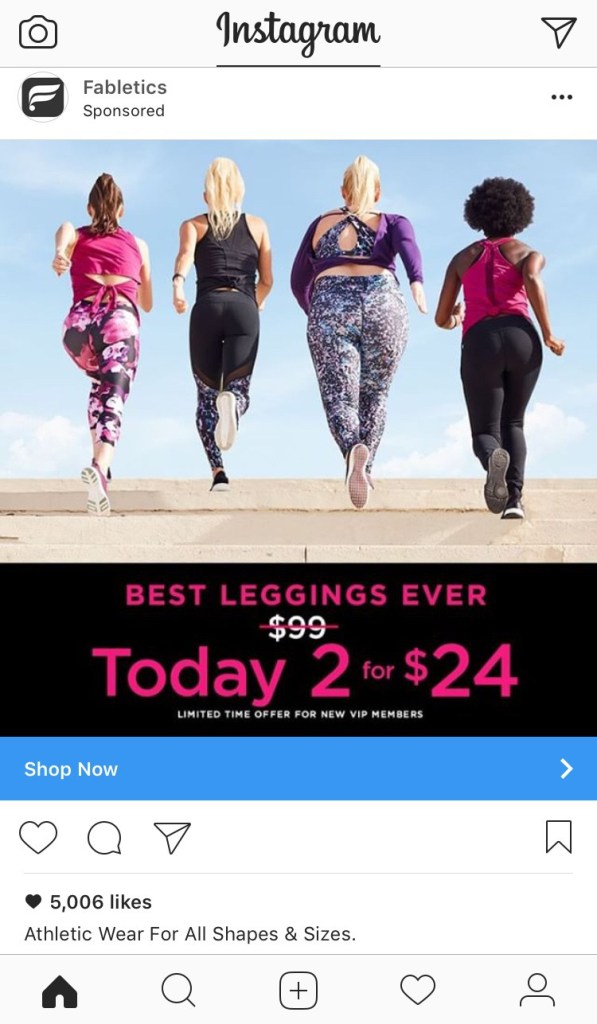
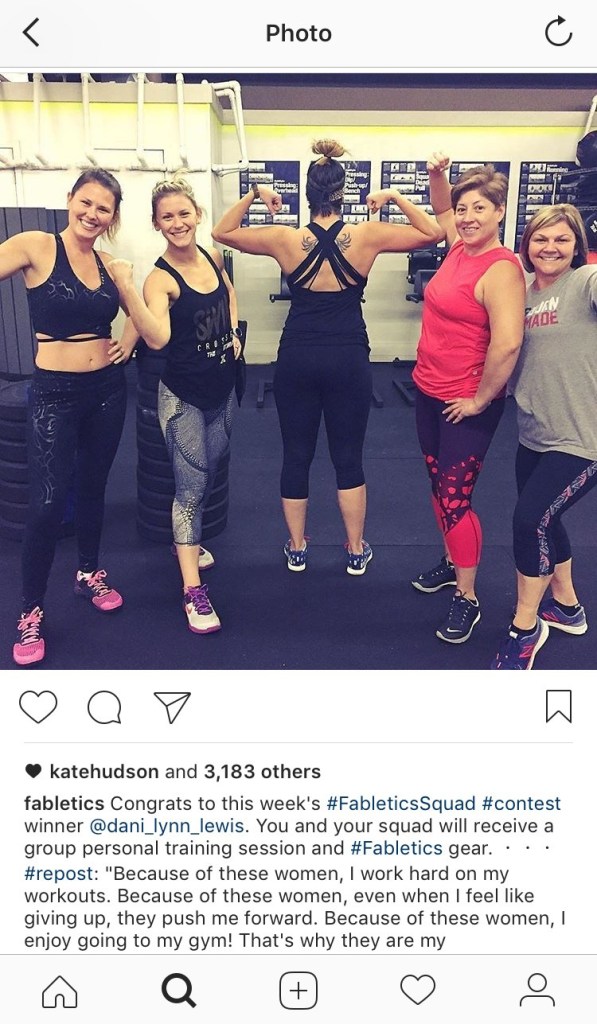
Fabletics is the athletic line by Kate Hudson. The following images are screenshots I took because I was really excited about the ad I had seen quite some time ago. The bottom right screenshot was the first one I had seen and then one day I went back and was checking out their Instagram feed to see if there were more like I had seen.

What really caught my attention was the body variety that had been chosen and included in the advertisement. I thought in comparison to the fitness images that normally come across my Instagram, I was caught off guard and I just stared at it for a moment. I think this kind of inclusivity is so important, especially in fitness, because the goal is for people to be healthy and not just a specific body type. I liked it because it made me feel incredibly happy to see Hudson’s company take this route in its advertising.

I think it is incredibly engaging, from getting a wider variety of women being represented, to asking for actual engagement. The top left screenshot was the result of contest, and I loved how the company put up their picture to put some every-day women in the spotlight. I think if I were actually participating with the hashtags and sharing content along with the others, I would probably feel part of the brand. But I will not lie, I felt more connected with the brand the moment I saw the girls in the ad.

If you read the captions of the photos you’ll notice until they get to #FableticsSquad they didn’t have any consistent message or hashtags the users could use. I think their ads and this campaign would have been more powerful if they used one continuous hashtag with all of them. Even though these visuals are very strong, I think the message needs to be there in the text. Hashtags are a great way for your brands fans and followers to come together and see each others content. It builds community. I have seen other fitness accounts be very effective in building brand relations and community through the use of a good message via a hashtag.


Take What We Can Get and Overpaying For It #DigCommSU

I don’t live in a terribly unpopulated area. It is a mix of being a suburb but stretches into rural. People think we are off the beaten path but a major route goes right through our little town and there are more humans than cows. Our options for internet access are limited. Some people can’t even have wired connections. They pay for those devices from their cellular network that provide wireless access. I couldn’t live that count-the-used-gigs life. They reach out to the big names and ask what it would take for them to extend to their area but they don’t have pockets $10,000+ deep. 

Begrudgingly, we use Time Warner Cable, or apparently Spectrum now. At every bump in the road their solution was to uprgrade our package. We’ve used their devices, tried our own devices (modems and routers) and yet it hasn’t made a difference in their service. It’s incredibly mediocre. The internet connectivity isn’t continuous. How do you lose connection when you’re hard wired with an HDMI cable? When the internet is considered a utility, it makes me wonder how people would react if other utility services functioned as poorly as my service from TWC/Spectrum. 

What if you were sitting in your house and it was normal for you to experience a blackout? What if you went to take a shower but your water wasn’t running? What if it was the dead of winter and your heat wouldn’t turn on? 

When you are trying to go back to school by taking online courses that fit around your schedule, it’s important that a utility, a service that you PAY FOR, that it works. It’s important that you aren’t paying for nothing. Even when the internet works it fades in and out, that is not what you pay for. Streaming speeds, and download time aside, its main purpose is to provide access and they cannot even do that. 

So we pay for the higher packages, it fixes the problem for a while. Shortly after that, the problem always returns and we are left paying higher rates. All I can do is challenge the company and hope that they are actually concerned with customer satisfaction and not just their bottom line, but I’m not holding my breath. 

I Always Come Back to Facebook #DigCommSU

I recently kept a diary of sorts, for one day only, to log my personal digital consumption.  I didn’t need the exercise to know that digital devices are a large part of my life or that I spend a fair amount of time engaging with digital technology throughout my day. However, the task was a good way to check in on the balance (or maybe lack thereof) I try to achieve between using digital devices for efficiency and for entertainment.

Over the course of any day, there are a great number of apps that I use. I love using social media. For someone who is not as good at continuous texting conversations as the rest of her generation, using different social media is just one way I stay connected to my friends and family. The reason that Facebook tends to be the social media of choice for me, is that it seems to be the most universally used amongst the people that I care about keeping in touch with. It has my family spanning across the age divides up to my 80 year old grandma  and reaches all the way across the ocean to my friends in Europe from my semester abroad.

Some of the other apps that I love and use aren’t as inclusive. Snapchat was not that big at the time of my traveling experience and only one of the friends I made, had already had the app. By the time I left, I had definitely brow-beated them into downloading the app knowing that it would be a great way to see their faces everyday long after our time at Uni was over. Snapchat is an app where I go to for a pretty limited group of people. I am not connected with very much family at all, and even when I consider the people from my age group that I’ve ended up connected with there is really an eclectic mix.

I love Instagram but I use that in bursts, when I’m feeling inspired by the things around me, or when I have something aesthetically pleasing to share. But frankly, my current state is not that glamorous as I lay in bed, in my pajamas still, just working on all of my homework. My Fitbit keeps jingling and telling me to move but little does it know I am being very productive.

I find Twitter at its most exciting during award shows or other times when you know people will be on to live-tweet events. Being able to engage in the conversation with so many people, and with the potential to reach celebrities (thanks for the tweet, Nick Carter) or other people that would normally seem out of reach, is what keeps Twitter relevant to me.

I think Facebook has been a remarkable company to watch and ultimately has provided a great service throughout its time. The people that run it have been very conscious to listen to their users. Their site and app are constantly being refreshed. They aren’t afraid to experiment with new ideas and I think its been a tremendous part of their success. Facebook is smart to include innovations that other companies have put out there, keeping them relevant.

For people like me, the mildly lazy communicator, why would I go to so many different apps to achieve all of these individual purposes/goals when I could do all or most of them on Facebook?

Fringe with Benefits #DigCommSU

In an article published on WIRED by Chris Anderson, he discusses a pool of potential waiting to be tapped by businesses referred to as the “long tail.” The long tail is essentially all of these products that are on the fringe of what is popular with the masses. In order to successfully utilize the long tail, your business takes advantage of all the data available about its customers. Consumers come to your site looking for the the book that everyone has been talking about, and based on their browsing history your site can guide them to similar titles that may not be quite as popular as what they had originally been shopping for. In the article, Anderson describes how retailers like Amazon opened up the availability to the fringe products to their consumers and the sales of those books that are not their top sellers account for more than half of their book sales. When a book seller is restricted to a store with a certain amount of physical shelf space it makes sense to limit the options for consumers to the titles that are best sellers. But when the internet makes it possible to endlessly shelve titles for consumers to peruse, the sales can obviously have a significant increase.

I thought it was an important distinction to make between a success story like Amazon and other companies that have tried only operating with the long tail spectrum of products and those that strictly stick with the popular products. Without the draw of the popular products, its hard to sell only long tail items. Why or how would a consumer even find you? On the other end, if you only sell best-sellers, you’re missing out on a wealth of opportunity.

In another article discussing the long tail found in The Economist, they too discussed the benefits of the long tail. This was focused primarily on the positives consumers will experience as more businesses employ this new business model. Both articles come to the same conclusion: the long tail is connecting people with products that they likely would not have had access to before. Shopping in this sense then becomes more about the individual. Sure, they lure you in with the trends but ultimately shoppers will flourish in the products that appeal to their individual tastes. There’s something so democratic about a business model that plays to individual tastes in this matter and it really resonates with me that it promotes this idea for people to choose products so much more specifically to their taste.

https://www.wired.com/2004/10/tail/

http://www.economist.com/news/finance-and-economics/21638142-consumers-reap-benefits-e-commerce-surprising-ways-hidden-long

My Dog Ate my Homework #DigCommSU

An article tweeted by The Hill last night was quite comical. It discusses the latest in the Trump transition, the hearings, and in particular the hearing of Ben Carson.

We all might remember Dr. Ben Carson from before the primaries, or maybe you don’t because there were so many republicans running for the bid. Either way— he is back as the Secretary of Housing and Urban Development nominee.

Peter Schroeder, the author of the article, explained how the written submission of Ben Carson’s testimony had some instances of plagiarism. He noted that this incidence was first shared by the Washington Post.

Apparently, Carson’s written testimony had un-paraphrased material without any citations or indication that it was not his own work. However, Dr Carson did not actually read the piece in entirety, instead he went off-the-cuff.

Now, for my favorite parts of this story. There was an update made to the submission in which the appropriate credits were included and Trump’s team stated that this had been a mistake. The following is the comment:

“It was a written statement for the record — his oral testimony, as I am sure you’ve heard, is extemporaneous and planned that way,” said the spokeswoman. “The original written statement was sourced with hyperlinks and footnotes, but unfortunately that seems to have fallen off.”

I wonder if that will work for students, should they forget to include their works cited page rushing to meet a deadline. Also, the next time I wing something I will be sure to use the word extemporaneous instead. I digress.

I hadn’t heard of The Hill until just recently when I was searching for news to follow on Twitter. I initially trusted it in part because it had the verified symbol, which meant this account was of semi-importance and legitimate. For the purposes of this story, I feel safe trusting the information because the same details can be found in other articles like the one Schroeder himself mentioned by the Washington Post. If a publication like the Washington Post has a similar story then I feel confident in the information here, especially after reading the article the WP published. The details of the story certainly matched up.

Despite the fact that another version of his testimony was later submitted with the proper citations, it says a great deal to me about a certain level of care and disregard. In all of my days of writing papers, a citation has never “fallen off.” These positions they are looking to fill through these hearings are important and if students can be expelled and given a proverbial scarlet letter for their plagiarism, why should we be accepting of people seeking to hold some of the highest offices in this nation to mistakenly turn in a version of a speech that has no credit being given, no links to check on where the information came from, and no citations? How does a version without those things even exist? I’d expect more care to be taken when preparing for one of the biggest interviews of your life. How far would the word “accident” go in other alleged plagarism situations?


Here is a link to the full story and the article by the Washington Post:

http://thehill.com/policy/finance/313984-carsons-prepared-congressional-testimony-contains-apparent-plagiarism

https://www.washingtonpost.com/news/powerpost/wp/2017/01/12/ben-carsons-prepared-hud-testimony-included-plagiarism-but-he-didnt-use-it/?postshare=9541484238723504&tid=ss_tw&utm_term=.e71e15c43cdc

A Little Something About Myself #DigCommSU

I am currently a teaching assistant in an Elementary school and work in a 1st grade classroom. Previously, I had been a substitute in this same district for about a year and a half before they hired me to work for them full-time.

I attended Nazareth College of Rochester for my undergraduate work and received my Bachelor’s in History and had a legal studies minor. It was actually through the course requirements for the legal studies minor that I came across the field of communications in an education setting. I finished my time at Nazareth with a semester abroad in Lancaster, England.

I had intended on pursuing a law degree upon my return to America but felt that there was something else out there that better suited my interests and career goals. I was looking at the law program at SU when I decided to browse their other graduate degree options. This was when I found the online communications program. After perusing the coursework and speaking with the admissions counselors it was very clear to me that I had found my next step.

I have minimal field experience other than running the social media pages for various campus clubs and starting the Facebook page for an old employer but I am eager to learn and excited to take these courses. I look forward to meeting and working with all of my professors and classmates I meet along the way.